The largest Bavarian Medieval Town unfazed in World War 2; so it's Germany's best preserved medieval cities.

Regensburg has at least 1,300 listed buildings of historic interest.
It was also the first Bavarian capital before Munich.
It was also the first Bavarian capital before Munich.

Behind is the 12th Century Steinerne Brucke (Stone Bridge), the oldest of its kind in Germany.


Under the bridge, it looks as though there are whirlpools. Legend has it that it was competing with St Peter's Cathedral for its completion and that "evil" could help it on the condition that there would be 3 sacrifices of blood. King Ludwig cleverly sent a hen, a dog and a cock across the bridge to the anger of "evil" thereby causing the waters to swirl as when the the hen flattered its wings!

Dad walked over to the other side of the bridge and found a pretty sight.

Picturesque Regensburg.

Picturesque Regensburg.

Before touring the Medieval city, the tourist guide showed us a overall view .

As we walked around , stories of the past related to kings and rulers were told and this pictorial representation of David and Goliath had something to do with approaching the constant threat of enemies with courage. Believe me when I say I have forgotten much.

The Altes Rathaus is the old town hall built in the 13th century and today still functions as one.


We saw a wedding going on but the bride is already on the way to be a mama.
On the right is the entrance to a part of the town hall and the 2 two bars had a story but I have forgotten what it was.

Teachers accompanied their students on a summer trip.


Gift shops offering toys and souvenirs were a common sight.


On the left is one of the many towers built by rich merchants and traders; the taller the building the richer the builder. It was a symbol of wealth and status in the Middle ages.

It is a fact that Regensburg is a city of lanes, alleys and high towers.


Towers on the left and right. Another juicy story revealed was that the local merchants copied buildings from Italy. Buildings may be of a few levels but only the ground floor is used. Apparently there are no stairs leading to the higher levels and that the tower is just for show. Again, the height of each building will reflect the wealth of the owner.


The tour guide told us besides tall towers, the existence of a well in the court yard of a building also means the owner is very rich in those days as they had the privilege of drawing water from it and not having to carry it from the Danube.


Cobbled lanes and stones were common and we strolled through miles of them while being given accounts of the city.


This was the entrance to the fort that protected the city from its enemies int he old days and today still under maintenance and care.

We had beer and sausage at the Historiche Wurstkuche (Old Sausage Kitchen).
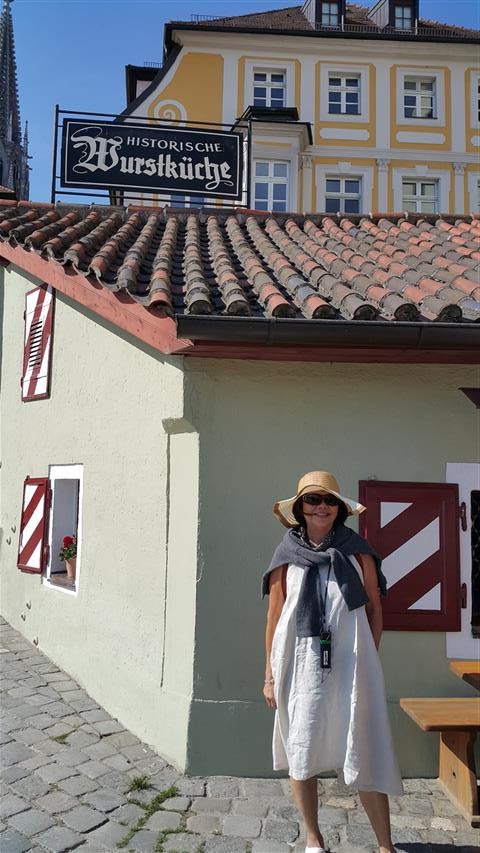
It was out of the world.

That's the everlasting Historiche Wurstkuche where no tourist in Regensburg can miss. If you miss the sausage here, you have indeed miss something.

St Peter's Cathedral is the eye catcher and is under renovation. The guide confessed that she has never seen it really completed. The whole building has to be constantly repaired.

In Europe it is always seeing castles and cathedrals.
The rich architecture of the Renaissance days are also apparent.
Regensburg is pretty and historical.
On an optional tour, we went by coach to Kelheim where we boarded a Danube Gorge Ship which took us through the gorgeous Danube Gorge to the Weltenburg Abbey.

Danube Gorge; Unesco site.

Cruising along the gorge was a peaceful ride and you admire the works of creation. It also reminded me of Halong Bay in Northern Vietnam.


We went through a stretch of waters that was crystal clear and unpolluted.
It is just beautiful landscape and we thank God for an opportunity like this.

This is the exterior facade of Weltenburg Abbey.


Inside the Abbey there were statues of saints and stories interpreted from the bible. It is a good way of depicting information for those who do not read nor write; like a chronology.

Outside the Abbey, is a Bavarian Lounge where all of us were given a treat to Bavarian beers.

In the hot afternoon, a glass of cool beer is the best quenching solution.

This part of Germany is not spared from floods.
The readings on the pillar record the occurrence of such floods.

There was hardly any shade and the hat saved me.
Yet, locals enjoyed the heat and took small boat rides along the Danube.
Then ends our memory of Regensburg.
On an optional tour, we went by coach to Kelheim where we boarded a Danube Gorge Ship which took us through the gorgeous Danube Gorge to the Weltenburg Abbey.


Cruising along the gorge was a peaceful ride and you admire the works of creation. It also reminded me of Halong Bay in Northern Vietnam.


We went through a stretch of waters that was crystal clear and unpolluted.
It is just beautiful landscape and we thank God for an opportunity like this.

This is the exterior facade of Weltenburg Abbey.


Inside the Abbey there were statues of saints and stories interpreted from the bible. It is a good way of depicting information for those who do not read nor write; like a chronology.

Outside the Abbey, is a Bavarian Lounge where all of us were given a treat to Bavarian beers.

In the hot afternoon, a glass of cool beer is the best quenching solution.

This part of Germany is not spared from floods.
The readings on the pillar record the occurrence of such floods.

Yet, locals enjoyed the heat and took small boat rides along the Danube.
Then ends our memory of Regensburg.


