Wednesday, July 20, 2016

Kenrokuen Garden

The Garden

This is never to be a miss when in Kanazawa. Japan's third best looking landscape garden brought us excitement and thrill and the morning drizzle did not dampen our spirit. We wanted to so badly witness the best of Japan.


Covering  an area of 11.4 ha, Kenrokuen is a strolling-style landscape garden of the Edo period designated as a National Site of Scenic Beauty on March 8 1922 and of Special Scenic Beauty on March 20, 1985.
So, be prepared to walk.
Thanks to the walk, we were able to cover our daily target of 10,000 steps.


 The entrance to the garden already impressed us with its proper stature and cleanliness.


As you stroll further pass one of the many gates, the trees tell tales and the age of the garden. The flora seems to exist here ever since and forever to come.
Roots are deeply implanted and trunks are thick and stable.
They must be very old.


We saw a special section allocated for one of the empresses and well defended.


Wood is the main building material ; light and easily built and replaced in the event of earthquakes . The Japanese are used to the calamity and rise up to the occasion to face any impending catastrophe. This is where home is; they don't run away but find ways to overcome it. 


We selfied and were proud of ourselves. When you have no one around you it is alright to behave young and foolish of course. But the cool, calm morning was a good change from the hustle and bustle of life,


The garden is home to the Koi and the species swam placidly without worries.
The fish is free of stress.
All species of flora bloom endlessly too.


Peace


 Serenity
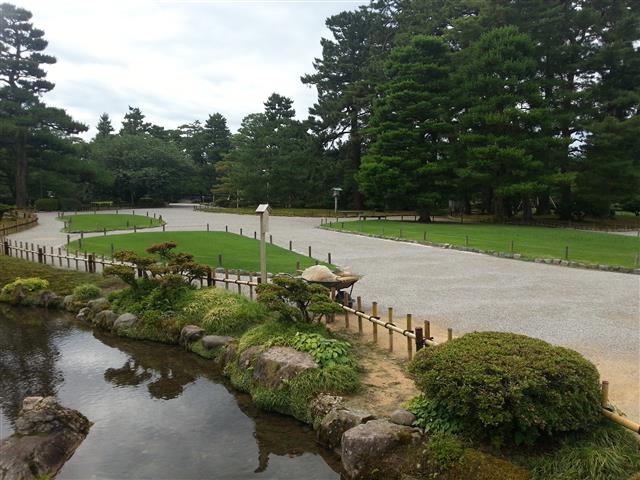


Calm


I noticed the care taker. Not very young but diligent in her duty. She was weeding and making sure her plot is well looked after and kept. I suppose every plot is allocated a care taker and a silent competition may be on. Who has the best looking plot? Healthy competition is needed for any upkeep.


Kenrokuen Garden practises 6 virtues one of which is cleanliness. So, the beautiful garden so similar to the ones in Korea was truly a sight to behold. Am I glad we were there. You like me with the background? It is not cut and paste.
 I was really there.

Thank you dear God for the experience.
The Kenrokuen Experience.

Kanazawa

The town is 4 to 5 hours drive from Tokyo and perhaps this was the longest stretch on the coach for a day in the trip. But it was pleasantly easy and enjoyable as we went though the scenic landscape of the outskirts. It is exactly dad's forte for he would exchange anything for this experience. 
The countryside verses the city and the latter is the preferred one.


A rest area on the way to Kanazawa; the restrooms are typically clean .


Once again, the local treats are in town but no to our taste though.


 Some dried sea food for sale but it would be a hassle to bring home.


 Chocolates and the like and the big eggs are all locally produced and consumed.


Through the ride we could not but realise that Kanazawa is blessed by rich plains of rich soil so suitable for padi growing. In fact we were informed that the rice grade here is tops and the best in the country; of the white and starchy one.


We reached Kanazawa at dusk when the streets and shops were about to close. Unlike Osaka, Kanazawa is modern, adorned by new buildings that are stylish and contemporary. We were ushered into a modern hotel next to rows of shopping malls. But alas, the shops cease transactions at 8pm and we hardly had time to scout around. 


In serene Kanazawa, you will associate it with utter peace and quiet.
Cleanliness is assured and rest for the evening complete.

Oyasumi nasai, the locals greeted us.

Tuesday, July 19, 2016

Kiyomizu Temple

The Second UNESCO Heritage Site

To Kyoto, the city of a million people which used to be the old capital. The coach ride from Osaka to Kyoto was an hour's ride. Clement reiterated that the old city is ancient though not spared from earthquakes. The buildings here are no architectural feats as they are not high rise and built to off set threats from impending quakes.
The roads follow a grid pattern and the city is surrounded by hills and ginko trees are everywhere to be seen along both sides of the main roads. The bullet train passes the city and of course it is clean and hardly can garbage be seen.
In Japan, the church building is a rarity and in fact not seen by us. The ancient temples are everywhere in sight and so our next destination again was to visit the famous Kiyomizu Temple of Kyoto.


Sited on a hill, walkers have to stroll a km or two before reaching the temple. At 10 am, the crowd was already coming in full force and it was again squeezing through human jams. Like walking up the Penang Kek Lok Si, you will sweat and puff. But it was a good walk to see what people of old had constructed and believed in.


I should think that some refurbishment has been done as the building looks new and bright from the outside. The handiwork has to be maintained as not only is it a money churner, it is also a place of worship for the Japanese.


 The architecture is quite similar to the temples of Korea as they are quite nearby and are of Chinese origin. The Japanese Language has used the Han letters to connote and communicate and both the Chinese and Japanese Languages are so interlinked. One need only to see the main Han character to understand enough to get by in Japan.


 From afar, the Kiyomizu Temple stands tall and majestic reflecting the works of old and till today still stand good. 
The panaromic view from the top is truly eye catching.


Notice the support that is built to hold the temple. It is an engineering feat and art. Dad could not help but admire the roof feature that has been installed and at the present undergoing refurbishment.


Nature is so beautiful here.


Of course, the Japanese cannot be apart from the holy water that runs down from natural streams. people thronged there to hold water, drink and cleanse themselves. This is so indigenous in Japan.


 We had our Bento lunch again. Second time running and we are still for it. We wondered at sushi and the other mouth watering cuisines that we ate at home. When are we going to be served that?


After lunch, it was again going round the shops and taking photo with girls in Kimono. 


 The sweets.


 Japanese craft is polished. Good quality and no compromise. Just make sure you buy a Japanese locally made one instead of one made in big China. The price is a contention too; very expensive what with the Ringgit's position.


Truly Japanese and truly nice too.


 Yes, the hat is a good shade.
How do you like my blouse?
I sewed it myself last year when I first retired.
 I was up to it to conquer sewing feats.
It is very Japanese right?


Enroute to Kanazawa, we stopped by Lake Biwa, the largest Japanese lake and the third largest in the world and took the love photo.

To Kanazawa.

Thursday, July 14, 2016

The Kasuga Shrine

Cradle of Civilization
UNESCO World Heritage Site

Site of some of the oldest sculptures in the land and known as the temple of a thousand lanterns, the Kasuga Shrine of Nara is a favoured spot of the locals steeped in Buddhism and Shintoism. Many come here to offer givings and prayers meeting their spiritual needs. The centuries of worship has made it a hard ground for other religions to penetrate the hearts of the Japanese. 
Clement was kind enough to show us this angle as this spot was originally not included in the package. It is good to understand the steep beliefs of the land.


The entrance to the shrine was labelled and entrenched in a big rock, a natural setting of the surroundings.


As you enter the gates, one cannot but help notice the strings of lanterns displayed. They seemed new; obviously the work of later times and their significance was not explained but can be easily deciphered; that they bring light to spiritual needs.


 We were impressed at the intensity of effort in maintaining the place of worship.
The Japanese are keen and meticulous workers and I would like to assume that they are honest workers too. 
Much care both among the men and women were observed.


Some older structures that needed upgrading were seen to and concerted effort again is observed.


As we continue to walk down, we were further amazed at the countless number of lanterns which truly ancient lined up along the path. Tourists of all nations are seen observing the practices of old; some of which are still practised today. Their beliefs have passed down from generation to generation.


 Rows and rows of old lanterns neatly lined up for the many tourists to see and make conclusions. As I have said, they must be asking for peace, harmony, protection and prosperity.


Further down, we notice the old branches and roots of trees intertwined with the lanterns ; only to remind us of the aged civilization.


True to what I thought, the tablet on each lantern did plead for protection and peace; some even favour. The spiritual needs are indeed genuine, No man can deny the existence of an almighty power.


 Of course, it is not surprising to see the wooden tablets held to panels again asking favours of all kinds; release from ailments; finding life partners, protection, success and everything else. As observed, this feature is even found at local towns and malls.


Some root features are without a doubt a reflection of the age of the place.
To see such an old civilization and place is an experience of a kind.
We are brought back to see how people believed and behaved then.
Are we still the same?


 The spring of hope is surely an inherent feature here; particularly in a place of belief. Many thronged to hold the waters in their hands and drink them hoping for blessings and favour. 


This picturesque representation is more than a thousand words can do.
We left scenic Nara for the city of Osaka to retire for the evening before the next agenda.

To the city.

As can be assumed Osaka is jam packed with people both locals and foreigners and the main activity here is none other than shopping. Like crazy ones, we could not resist the big boys in town; H&M, Urban Research, Nike and it is endless. Dad detested the crowd and wished a thousand times to be back in the countryside.
It was super crowded and shoppers bought as though there was no tomorrow. Osaka is tight alright.


But amidst modernity and change, the old practice for the July 7th legend still remains strong. Young lovers are seen hanging their wishes and prayers hoping all good and bright will happen to them.
This is the uniqueness. Times make change but hope always remains.

The coveted rest was given to us as we parked ourselves in a comfortable hotel.