Saturday, August 13, 2016

Mount Fuji


En route to the coveted spot of Mt Fuji after the wasabi experience, we put a night at Matsumoto.


In Matsumoto, we were introduced to the oldest castle in the prefecture of Yamanashi. Well, to me it is so alike the castles in Korea as they are neighbours and carry architecture similar to each other.


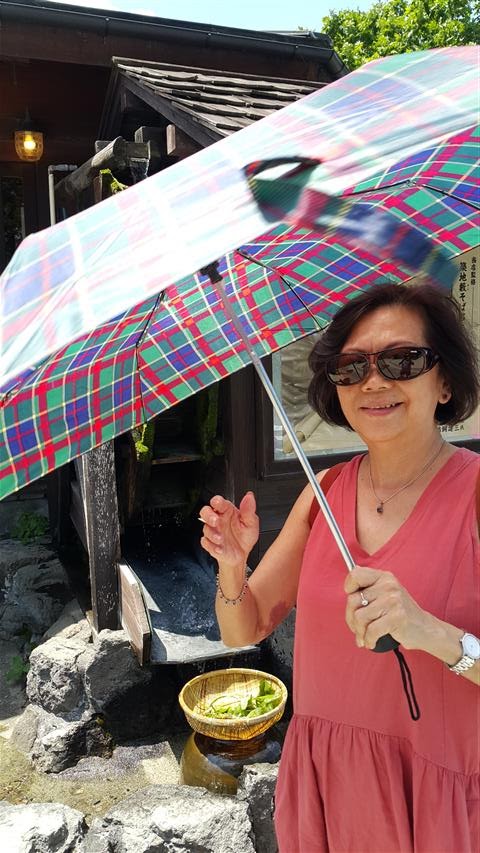
With a moat around it, the castle is the most visited spot for tourists I guess but the hot afternoon with its strong breeze took a toll on my umbrella. It overturned and I lost it ! This is what I remembered of the town.


The evening though was quite authentic as we got to experience to dress ourselves in their different forms of kimono known as montsuki? It was truly a chance of a lifetime to be in them. They were placed at the hotel we stayed for the night.


The futon bed together with the tatami mat was a final touch to our Japanese experience. But I am afraid that I have to confess that it was not altogether comfortable as getting up in the night to ease was a challenge. Given a choice, I would still go for the conventional bed. But nevertheless an experience I would hate to miss.


The Japanese Koi was a friendly lot; at least they like dad. He loves the species and has never stayed in a house without them. Yes, dad must have fishes wherever he puts up a home. So, it was a mutual affection.


This was the group that travelled together throughout the 8 days. All 29 of us come from all sorts of background but there were at least 3 teachers among us. Most travelled as families taking the Hari Raya break reason to be together. It was nostalgic as I recalled the days when dad and I travelled with our girls. Now it is getting extremely challenging to make a trip together. Truly challenging.
We dressed to the night for the group shot; didn't we?
We jolly well sleep well.

For the next day we went up the most talked about place in Japan.

Mount Fuji is graced by different levels according to heights.
Many have scaled it but never try to venture it alone.
Clement told us that an Ipoh young student lost himself and his remains to be found only many years later to the agony of his parents.


Yes, thank you dear God for a chance to be photographed with Mount Fuji behind us. It was easy to teach it as a subject in Geography but altogether different to touch its soil. It was hot but cool at the same time.


Dad took a panoramic shot and yes a shot to be etched in our memories. I am glad I can record all the experiences for us to recall in our older days.
 It was unforgettable .


Some are even more adventurous as they put up nights at the site; to explore in greater details. So, it is not surprising that hotels are available for rent and stay.
It is not cheap though as the products sold at the souvenir shops were hiked up in price. Truly to capture the tourists.


Horses are here for rent too. We saw many hikers ready for the climb and there were guides willing to help them make the climb.


Here, tourists of all nations are seen.
Many came for the highest mountain in Japan and see its beauty.


If you ever have a chance to be here, this is the first spot that will greet you.
Very touristy and cheerful.


In our 60s, we look forward to more experiences that will add enrichment and rest for ourselves. When children cannot travel where we go, we still hope we can make a good trip with them someday too.
 Mount Fuji was a great maiden visit.

After Mt Fuji, it will soon be time to go home.

Sunday, August 07, 2016

The Wasabi Farm


Daio Wasabi Farm
I have heard and consumed wasabi especially when I have Japanese treats. But to see how the plant is grown is surely the first time I have experienced. It was a learning visit as we witness before our eyes how the plant thrives. Apparently there are some nutritional value attached to the plant but the obvious reason is the punch you receive when it accompanies Japanese cuisines.


Clement told us that the Daio farm in Matsumoto is probably the biggest in Japan producing wasabi. The plant is sensitive and several physical conditions must first exist for its growth.


The journey to the farm was across tunnels built to overcome the rugged terrain on the Japanese Alps. It was breathtaking as you go through thick and beautiful greenery, pine trees,conifers and deciduous trees. Cedar trees are abundantly available perhaps as timber for construction. The hilly ride cut across ridges but the roads were well built.


That's the best representation of the plant. 
I could not resist a photo with it.


The summer heat was scorching and wasabi ice cream was the antidote.


A sumptuous Bento treat with of course the Hida beef.
Lunch was so delicious accompanied by most things wasabi! 


Witness the picturesque landscape with its mountainous background and streams of flowing water from the Alps.
Yes, the conditions for good wasabi harvest include cool, clear flowing water from the Alps and shade. This Azumino town has everything bestowed for wasabi growing. It is amazing to see the cool waters flowing through the fields without break.


This is how clear the water can be. 
You can almost see everything below that cover.
 Pebbles and deposits of varied kinds line the bottom of the bed and easily accountable. That's how the water flows here.


The summer sun is avoided by the vast coverage of the net.
Wasabi must have a constant flow of water flowing across its growth with extensive shade.


Please be informed that across each row of wasabi plant is seen a stream of flowing water; probably constant as it comes down from the nearby Alps.


Therefore it is true that wasabi cannot just grow anywhere.


It takes 2 years for a wasabi plant to mature and it can grow to a length of 4 inches. This place has the biggest wasabi farmland in Japan.


Besides the wasabi plant, we had the opportunity to see the natural surroundings of this pristine landscape and the indigenous flora growth. 
It truly was worth a visit.


Of course, we were tempted with the wasabi plant on the way out. You can actually grind yourself at home and be assured of the originality of it. The supermarkets may not be able to display such a pure version of it and some concoction may have been involved. However, how does one take them home?

The Wasabi Visit In Matsumoto.

Thursday, August 04, 2016

Takayama Jinya

The Edo Era

We were fortunate to be brought to an old government office of the Edo Period.
Here we witness some of the practices and lifestyle experienced by the officials then. Somehow, we can conclude that the hierarchy practices are obvious and we also saw how a local government carried out its duties of all sorts.

A peek into the building can tell us stories of all kinds.
But I must confess I have lost the chronology of the walk and I can only relate to what I have remembered about the photos taken.


At the entrance of the Jinya building, we were greeted by Japanese ladies selling the usual market goods such as miso paste, rich rice, pickles, flowers and fruits. Rosy cheeked and polite, the Japanese womenfolk here seem overworked.


 Tickets were purchased and Clement told us that a walk around the premises of the building would be best practice. Many words are saved just by observation.


 My husband look for different things. He told me about the roof, the wood and the like which to me seem all the same. I do admit we are attracted to different features and I would tell him about how the locals cook and live then. We surely have unrelated stories. But nevertheless good for each other; unlike poles almost always attract.


This is how the outside is constructed; all seem light and easy and ready for any impending earthquakes. Located in the heart of tectonic movements, quakes of smaller scale must happen everyday so as to release tension. The Japanese have succumbed to this fate and are used to it. No fear anymore.


I think this is equivalent to a court ? Judges sit in a row to cross examine cases and the prosecuted probably had to sit not beyond the barricade.


Surrounding the building are passages of the above which lead to different sections used for the multitude of functions. So neat and clean. 


At a certain quarter, the men tried to decipher how heat is transmitted to the kettle for boiling water. Great living skills.


Attached to a section is a small kitchenette for simple cooking.
We were mesmerized by the utensils of the then century.


 This could be living quarters for government officials and their families.
Notice the mat on the floor. It is the only material which is used for floors.
Cooling and sleeping on the mat must be good for the back.


Nothing is Japanese enough without a garden. The garden must be an outlet for stress and rest. After a hard day's work, it is imperative that a walk in the garden be done for the good of the mind and heart.


I believe this is the top official's wife's quarters.
Perhaps this is the waiting area for guests.


Yes, it must be. 
When guests aplenty are here to see her, this was where they waited.


 While that was a small kitchen, this must be a big one for maid servants to prepare meals for the whole battalion. Heavy utensils are seen here and chunks of wood are used as fuel.


I had a first hand manipulation on the kettle.
That's how people of the past boil water. 


Exhibited along with the kitchen were samples of ceramics used for bowls, spoons and pots. So very Chinese too.


We were exposed to the types of torture machinery used on prisoners too.
They looked decent but we believe there were more to it.


 The helmet and the armor. 
That must be the attire of the Japanese militant.
There were also short excerpts of high ranking officials of the Edo Era and their contributions to the nation.


This truly caught my attention.
Taxes paid in the form of sacks of rice.
Farmers grow rice to give away as taxes.
The feudal system was surely reigning then.


The walk was more than 30 minutes and at the end of the peek, we were reminded that recycling was the common practice here. We saw this officer separating the garbage and kept them for recycling. Such is the discipline here.


Before we left the place, we went to ease ourselves and this was where we found water recycled for flushing purposes. The Japanese are creative alright.


Goodbye Takayama Jinya.
We had to move to our next destination; the wasabi fields.